Tencent Music Launches Ad-Supported Free Music App as Free-Traffic Battle Heats Up
In a decisive push to win the free‑traffic war, Tencent Music Entertainment Group (TME) unveiled a lightweight music app called Free Music on the Huawei AppGallery on 10 September 2026. The service eschews subscriptions in favor of advertising and task‑based rewards, offering a free‑to‑use listening experience.
The launch comes amid fierce rivalry in China’s streaming arena. ByteDance’s Douyin‑partner app, Qishui Music (Soda Music), logged 167 million monthly active users (MAU) in June 2026—a 68.7 % year‑on‑year jump that brings it close to QQ Music’s 189 million MAU. In contrast, QQ Music’s MAU dipped 0.7 % year‑on‑year, while Kugou and Kuwo fell 10.7 % and 18.5 % respectively.
QuestMobile data shows Qishui Music’s growth rate is the fastest among Chinese music apps in recent months, prompting TME to rethink its user‑acquisition tactics. In its Q2 2026 earnings call, CEO Liang Zhu noted that “the growth of music‑related business has slowed down, and the pressure is mainly concentrated on the traffic level.” He added that lightweight products would help tap the free‑user market.
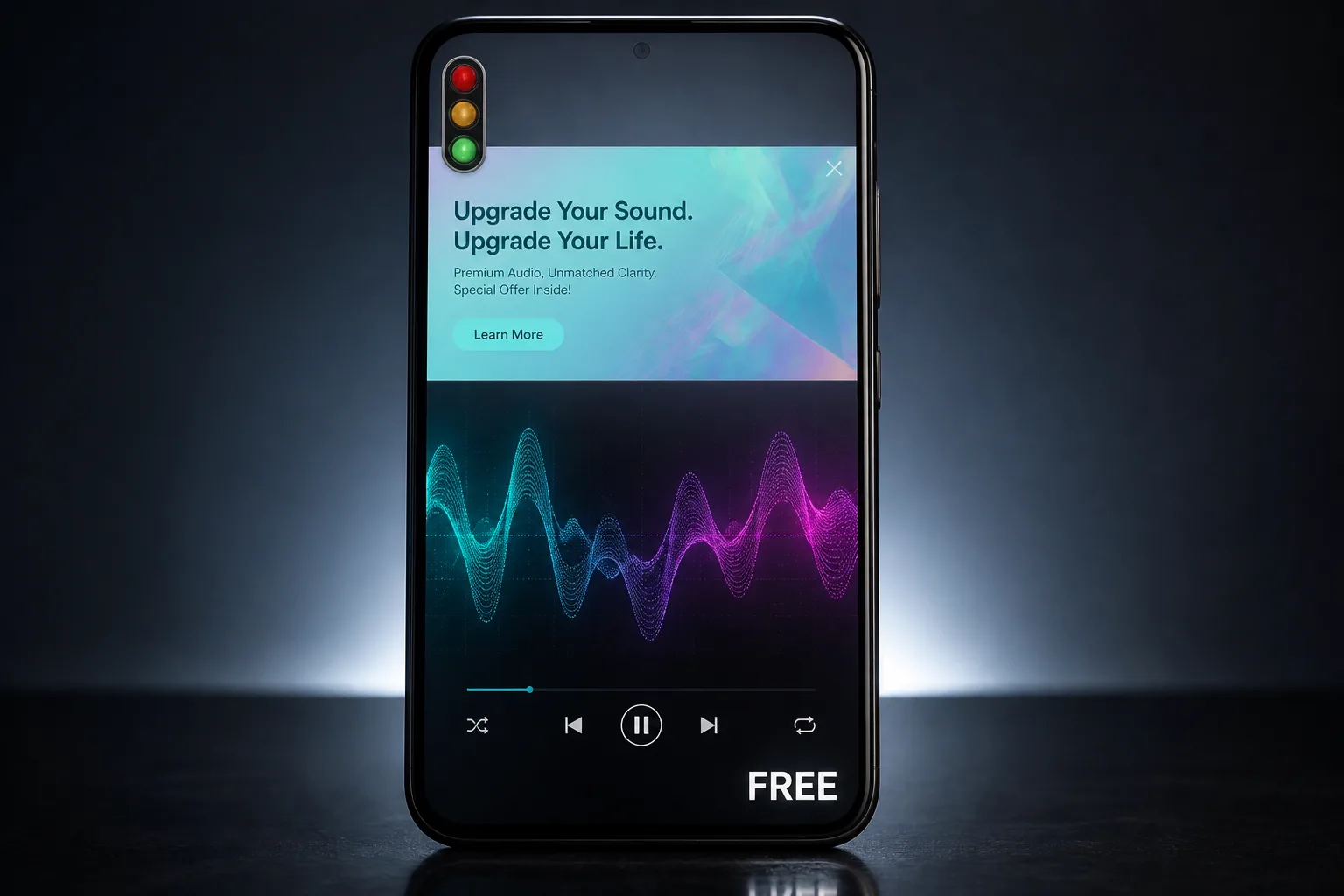
Free Music keeps the familiar QQ Music layout but strips it down for quick, ad‑supported listening. The main navigation offers Home, Swipe to Listen, Benefits, and My. The Swipe to Listen tab delivers a short‑video‑style feed: users swipe up or down to play the next track, with album art as the backdrop and song details at the bottom. The Benefits tab runs a “watch‑ads‑to‑listen‑for‑free” mechanic—watching a 15‑second ad or completing a short task earns 30 minutes of listening time, while a daily check‑in adds 10 minutes. Accumulated listening time can be redeemed for ad‑free streaming without a subscription.
Unlike Qishui Music, which blends a free tier with an SVIP subscription, Free Music currently offers no membership entrance. The app relies solely on advertising revenue and user‑generated listening time, fitting into TME’s broader strategy of separating high‑value paid users—who drive membership revenue, concert ticket sales, and digital album purchases—from the larger pool of casual listeners.
TME’s Q2 2026 financial results show total revenue of 8.93 billion yuan, up 5.8 % year‑on‑year. Music‑related service revenue rose 11.0 % to 7.61 billion yuan, while membership service revenue increased 8.1 % to 4.79 billion yuan. After consolidating Ximalaya’s revenue of 407 million yuan, the core business grew only about 1 % compared with the same period last year, indicating that most of the 5.8 % overall growth derives from the newly acquired unit.
Free Music is part of a suite of lightweight offerings that TME has been expanding since 2020. Boud Music, launched in December 2020, was an internal free‑mode product aimed at Generation Z users and later evolved into the “QQ Music Lite” experience. In Q2 2026, TME also released a free version of Kugou Music and continued to test ad‑supported listening for non‑premium users on QQ Music.
The app’s integration with WeChat’s AI assistant, Xiaowei, lets users search for songs, generate playlists, and play music via voice commands, extending reach through the broader Tencent ecosystem.
By launching a dedicated free app, TME signals that free‑traffic competition is being treated as a separate business line. While its core paid‑user base remains stable, the company is actively broadening its user base through ad‑supported, algorithm‑driven experiences.
In short, Tencent Music’s Free Music app marks a strategic pivot toward capturing the growing segment of listeners who prefer free, lightweight music consumption. The launch arrives amid rising competition from ByteDance’s Qishui Music and underscores TME’s effort to balance high‑value subscription revenue with a widening free‑user funnel.