Broadcasters Push for AM Radio in New Cars While Fighting Performance-Royalty Bill in Congress
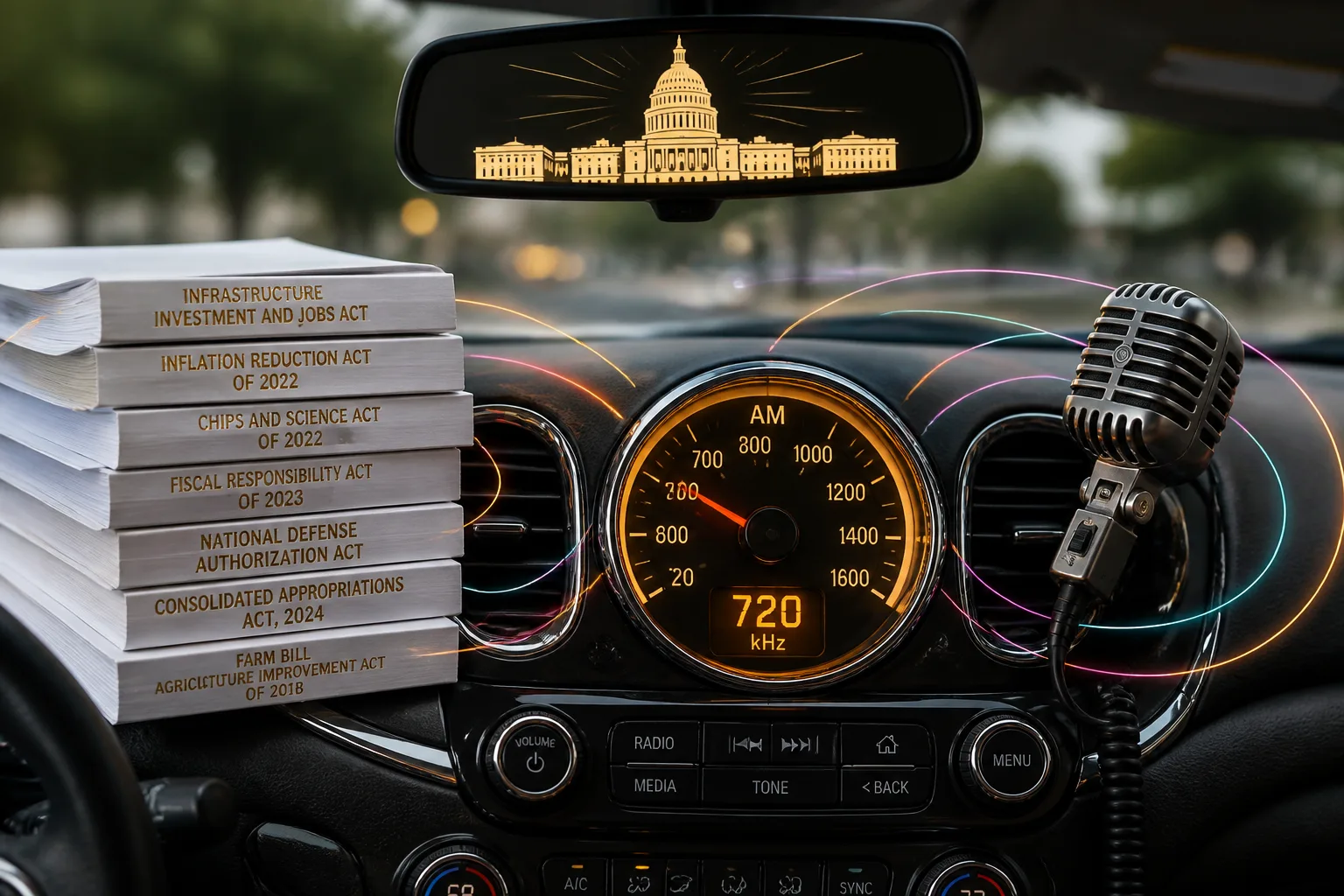
Broadcasters are intensifying lobbying efforts to keep AM radio available in new vehicles while simultaneously opposing a proposed performance‑royalty bill that would require broadcast stations to pay for music use. The two initiatives—AM Radio for Every Vehicle Act (S. 315/H.R. 979) and the American Music Fairness Act (S. 326/HR 861)—are moving through separate tracks in Congress and have very different levels of support.
The AM Radio for Every Vehicle Act, introduced in 2024, would mandate that automakers include AM radio receivers in all new cars, trucks and SUVs. The bill has bipartisan backing and, according to congressional data, has more than 370 co‑sponsors in the House and Senate. It has already secured a filibuster‑proof majority in the Senate and is being considered by the House Energy and Commerce Committee. The legislation is framed as a public‑safety measure that preserves a critical communication channel for emergency services and a diversity of voices on the airwaves.
In contrast, the American Music Fairness Act would close the decades‑old terrestrial radio loophole by requiring AM and FM stations to pay a per‑play fee to performers and record labels. The recording industry has pushed for the bill, but the National Association of Broadcasters (NAB) has long opposed it. NAB President and CEO Curtis LeGeyt told Inside Radio that the organization has offered a compromise that would tie radio royalties to digital‑royalty mechanisms, but the recording industry has refused to negotiate outside of its one‑sided proposal.
LeGeyt said the two issues are distinct and have very different congressional support. "The AM legislation has hundreds of co‑sponsors, while the royalty bill has roughly a dozen," he said. "We’re focused on preserving AM radio in vehicles, not on broader broadcast policy debates." He added that the AM bill’s narrow focus keeps it insulated from the royalty fight.
The timing of the two efforts is significant. With the current congressional session ending in August and a new Congress likely to convene in January, House Minority Leader Hakeem Jeffries (D‑NY) has already blocked the AM bill from being attached to a must‑pass budget bill in December 2024. Jeffries has also signaled an intention to link the AM issue with the royalty debate. Rep. Nanette Barragan (D‑CA) echoed Jeffries’ position, saying she and Jeffries believe the two issues should be tied together, but that the House has not yet taken action.
In response, the NAB has organized a fly‑in of broadcasters from 31 states to Capitol Hill this week. The group aims to keep the AM bill on lawmakers’ radar amid competing legislative priorities. "We are going to ensure that this bill has a lot of different options to get over the finish line," LeGeyt said. "Whether that is a standalone vote in both the House and the Senate—or it’s connected to larger legislative packages—we’re going to push for this provision’s inclusion in any of them."
The AM Radio for Every Vehicle Act is particularly relevant for the growing electric‑vehicle market, where interference from power‑train electronics can degrade AM reception. Automakers such as Toyota, Honda, GM and others have lobbied against the bill, arguing that it would impose unnecessary costs. The NAB counters that the legislation would preserve a vital public‑safety channel and that AM radio remains an essential feature for many drivers.
The American Music Fairness Act, meanwhile, is part of a broader industry push to align terrestrial radio compensation with streaming and satellite services. The recording industry claims that the current loophole allows radio stations to play music without paying performers, a practice that has been in place for decades.
As the current session of Congress winds down, the NAB warns broadcasters not to become complacent. "We’ve been doing this long enough to know that it only takes one Congress for members to advance a bad law," LeGeyt said. "We’ve got to stay vigilant on this firewall."
The outcome of both bills will shape the future of terrestrial radio. The AM Radio for Every Vehicle Act is poised for passage in the Senate, but its fate in the House remains uncertain. The American Music Fairness Act faces a much steeper uphill battle, with limited congressional support and strong opposition from the broadcasting community.
The next steps will depend on the political composition of the House after the November elections and the willingness of lawmakers to separate the two issues or combine them into a single legislative package.